Preparing my documents and return envelope
The copies, photographs and self-addressed envelope I took with me.
Prefer the short version? Read the step-by-step checklist for the documents and official links.
There were two kinds of preparation for my appointment: the documents showing my identity and history, and the practical things needed to get my documents back to me.
Some of the evidence was straightforward, such as my birth certificate. Other pieces needed a bit more thought, because they related to my childhood and the paperwork I had used before becoming British.
What I took
This is the list I recall taking for my own application. It is useful as an account of my preparation, but the High Commission’s current ID instructions (opens in a new tab) are the place to check what is needed for your circumstances.
- My completed ID application form.
- My signed and witnessed dual-citizenship declaration.
- My current passport, with the original and a copy.
- My original Kenyan birth certificate and a copy.
- A copy of my certificate of registration as a British citizen.
- Copies of both sides of the relevant page in my mother’s Kenyan passport, where I had been included as a child.
- A copy of older entry or residence evidence recorded in a passport.
- Copies of the front and back of both parents’ Kenyan national IDs.
- Passport photographs.
- A prepaid Special Delivery return envelope, addressed to me.
The older passport and residence records were evidence from my own history. They do not mean a British citizen needs to obtain a current UK residence permit. I would ask the High Commission what it accepts if a particular document is missing or the history is different.
For organising the papers, I would put originals and copies in separate sections and check each item against the current list. I would also check the photograph specifications before having photographs taken.
The return envelope I bought
I bought a prepaid Royal Mail Special Delivery envelope covering up to 500g. The photo below shows the type of envelope, including the weight marking and the address panel.
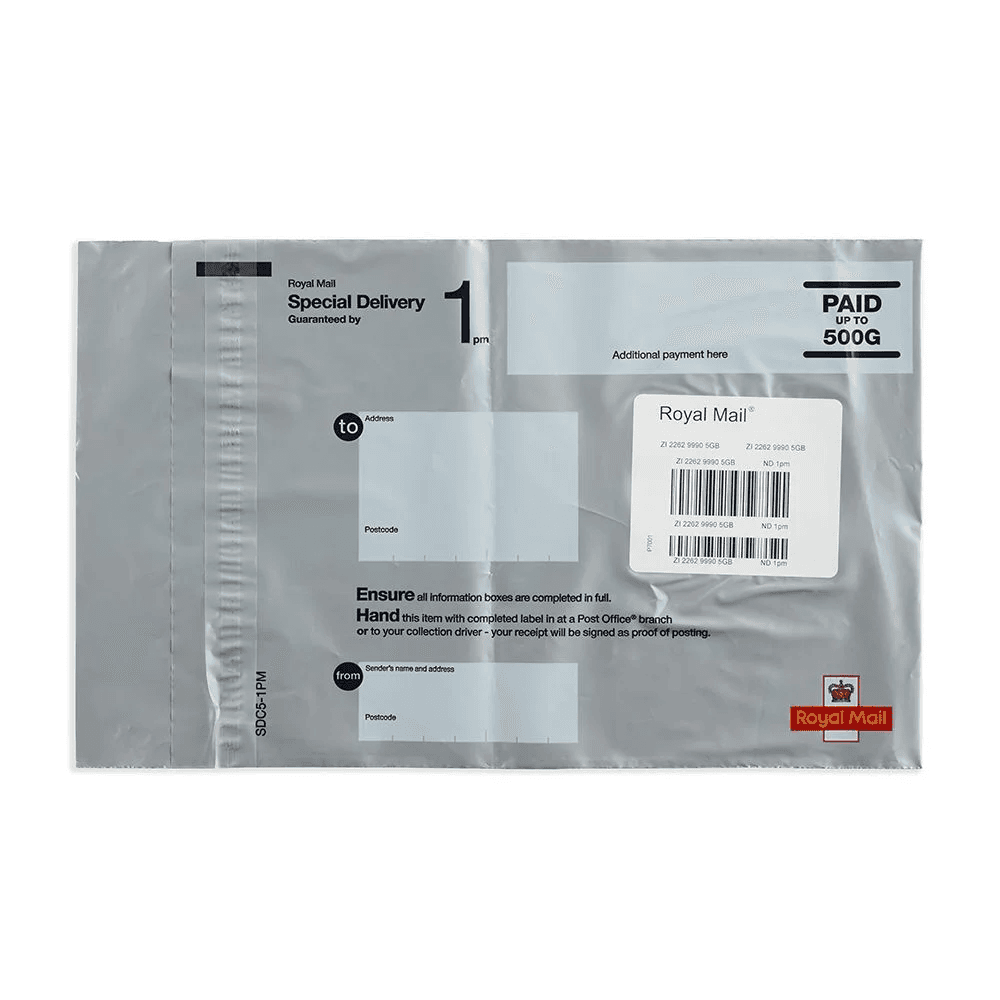
I wrote my own name, full address and postcode on the destination panel. This was the envelope for the High Commission to send things back to me, so the destination was my home address.
The 500g service is what I used. Before buying one now, I would check the High Commission’s return-postage instructions and ask at a Post Office for a suitable prepaid, trackable envelope with enough postage for the contents. An ordinary empty envelope would still need the appropriate postage.
I took one return envelope to my appointment. Product designs, prices and the weight needed for a particular set of documents can vary, so I would use the photo to recognise the type rather than assume that every application needs this exact product.
My ID eventually arrived in that same envelope, together with returned paperwork relating to the declaration. That was my return delivery; the final post in this collection explains a little more about it.